TensorFlow versus native PyTorch
This comparison covers five modification-aware RP cohorts and seeds 17, 29 and 43. PyTorch is the maintained backend; TensorFlow predictions are retained as a reference. The reference uses the historical TensorFlow architecture with AdamW, not the original publication's complete training procedure.
Held-out accuracy
Mean ± initialization-seed standard deviation; RT errors are seconds. Lower RMSE is better. These are individual fitted models, not ensembles.
| Cohort | TensorFlow RMSE | PyTorch RMSE | TF MAE | PyTorch MAE |
|---|---|---|---|---|
| E. coli crosslinks | 256.4 ± 2.0 | 253.9 ± 2.6 | 169.6 | 166.3 |
| E. coli pLink crosslinks | 337.0 ± 11.3 | 321.7 ± 3.5 | 218.7 | 204.1 |
| FA crosslinks | 256.2 ± 2.8 | 288.7 ± 4.5 | 196.5 | 227.2 |
| FA linear peptides | 613.1 ± 42.7 | 630.0 ± 25.4 | 462.5 | 469.2 |
| E. coli linear peptides | 160.8 ± 3.2 | 187.1 ± 34.5 | 109.5 | 131.8 |
PyTorch has lower mean RMSE on two cohorts. The E. coli crosslink difference is small; the larger PyTorch deficits are FA crosslinks (+12.7%) and E. coli linear peptides (+16.4%). The latter also shows substantially greater seed variation. Framework replacement alone is not evidence of accuracy parity.
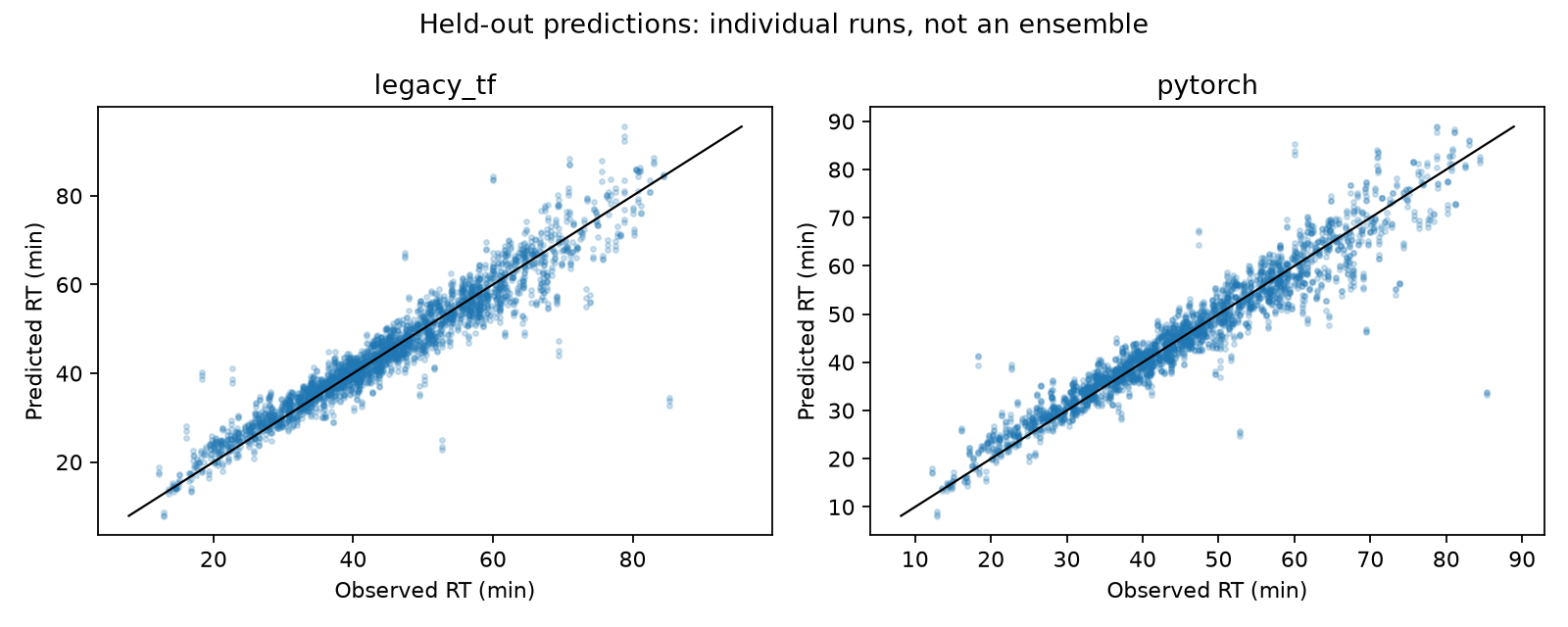
Both models predict the broad RT range, but the diagonal scatter should not be interpreted as independent replicates: the three seeds predict the same held-out pairs.
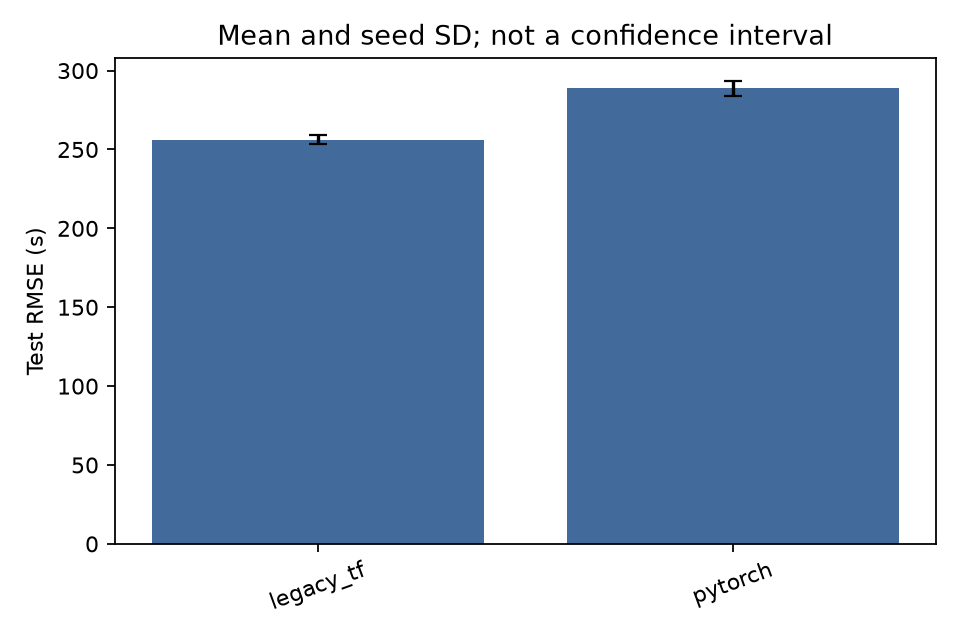
The FA-crosslink PyTorch error is consistently higher in this partition. That cohort has only 108 held-out pairs, limiting conclusions about broader chromatographic performance.
Protocol and retained evidence
The original scheduled run selected candidates using validation loss before evaluating test rows. Paired models use the same grouped partitions and training-only target normalization. Its effective recurrent/head architecture accounts for historical dense-activation behavior rather than assuming that identical YAML implies identical computation.
All 30 selected TF/PyTorch checkpoints have archived training, validation and test predictions. The regenerated validation and test predictions agree with the recorded predictions and metrics within the archive's tolerances. Native checkpoint exports were checked against the same held-out predictions.
For each cohort, benchmark-tf-torch/<cohort>/results/ contains:
tables/predictions.csv,metrics.csvandtest-summary.csv;plots/predictions.png,residuals.pngandrmse.png;data/with observations, token identities, grouping and partition manifests;models/with original selected checkpoints and native model/pretraining exports;provenance/with configuration, source snapshot and verification records.
archive.json indexes the retained files with SHA256 hashes. Recompute the
archived metrics with bash run.sh verify; this does not load TensorFlow.
Limits
Three seeds share one partition; they measure initialization variability, not biological replication. The five cohorts are related views of two studies. Results do not establish performance on a new acquisition or study. Selected training and inference timings in the original run are harness measurements on a shared host, not general framework throughput guarantees.
The native fine-tuning experiment is a separate fixed protocol and must not be treated as another candidate in this validation sweep.