
PEPTIDE SEQUENCES, CHROMATOGRAPHIC BEHAVIOR
Retention-time prediction
for peptide sequences.
Train PyTorch models for linear and crosslinked peptides. Predict continuous retention times or fractions, adapt a saved model, and keep the preprocessing and split information with every result.
Python 3.12-3.14 / CPU or CUDA / Apache-2.0
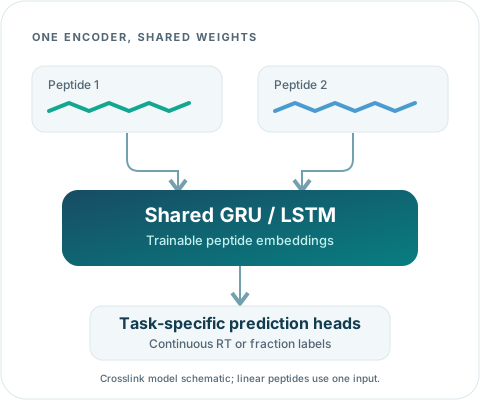
From input table to reusable model
-
Train with your data
Choose continuous RT, categorical fractions or ordinal targets. Make input columns, modification encoding and scientific partitions explicit.
-
Adapt a checkpoint
Update the full recurrent model, train frozen-encoder heads, or add GRU LoKr or LoRA adapters. Reuse the base vocabulary and target transformations.
-
Keep results traceable
Retain the model, encoder, effective configuration and split IDs together. Distinguish held-out predictions from training and validation rows.
Start with a working example
Install the xirt-torch distribution; import and run xirt.
Use Python 3.12-3.14 in an isolated environment.
Edit the generated configurations for your table's columns and targets. The installation guide covers environments, optional dependencies and the full training command.
git clone https://github.com/gieses/xiRT.git
cd xiRT
uv sync --locked --extra cpu
uv run --no-sync xirt --version
The cpu extra selects CPU-only PyTorch wheels. Use the mutually exclusive
cuda extra on a compatible NVIDIA host.
# From a source checkout:
uv sync --locked --extra cpu
uv run --no-sync marimo edit examples/train_predict.py
# Or run both notebooks without a server:
make examples
The CPU notebooks include 2,048 observed peptide pairs, checkpoint-based prediction, all four fine-tuning strategies and saved PNGs. Training uses validation-based early stopping.
Compare the measured results
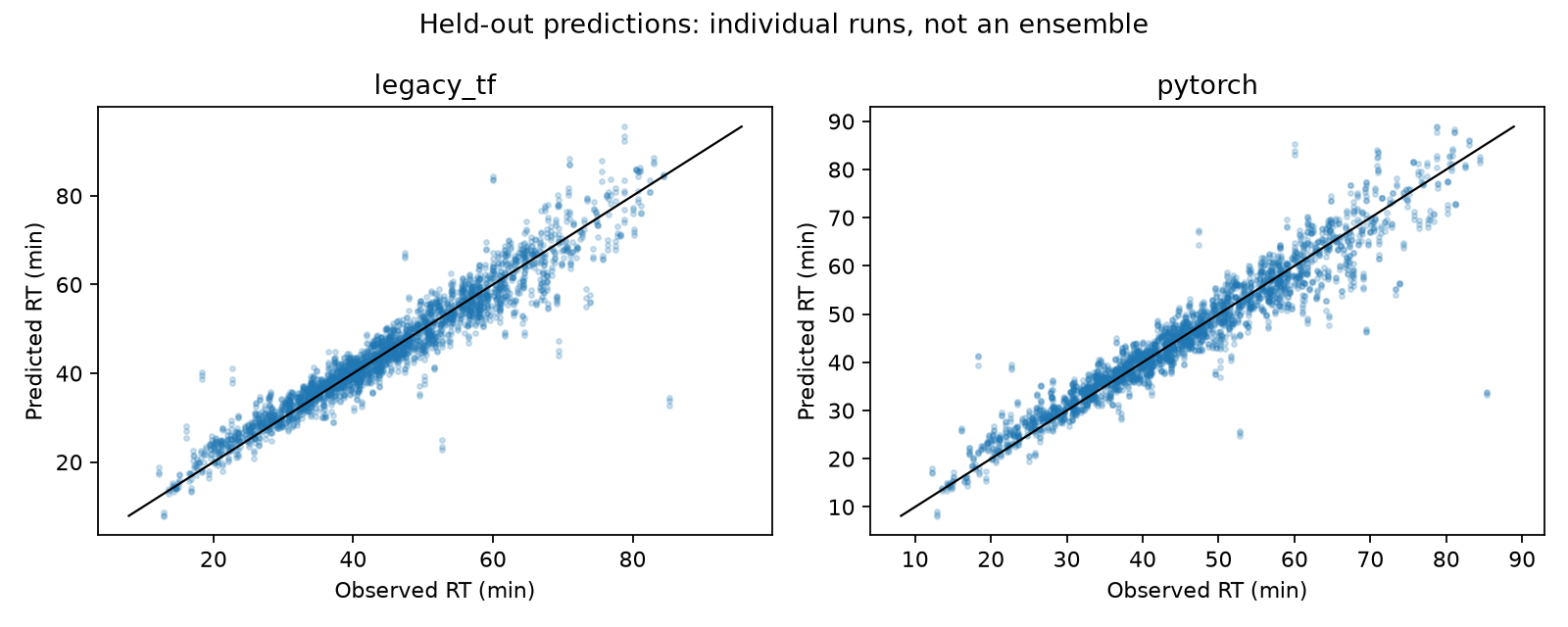
The framework comparison uses five modification-aware RP cohorts, shared partitions and three initialization seeds. PyTorch has lower mean RMSE on two cohorts; TensorFlow remains more accurate on three.
Full fine-tuning has the lowest mean RMSE on all five cohorts in the separate, fixed four-strategy comparison. The cohorts are correlated views of two studies, not independent external-transfer tests.
Find your next step
| Task | Read |
|---|---|
| Run your first model | Installation and CLI |
| Follow a complete, runnable example | Training and fine-tuning notebooks |
| Work directly in Python | API reference |
| Reuse a 1.x workflow | Migration guide |
| Evaluate optional protein-language-model features | ESM-C and adapters |
| Contribute or publish a release | Development guide |
A new backend, not an HDF5 converter
xiRT 2.0 uses native PyTorch checkpoints. TensorFlow/Keras .h5 and .hdf5
models cannot be loaded; keep legacy predictions for comparison and retrain
for 2.0. Optional ESM-C features are experimental here and do not preserve
the recurrent model's modification-aware input representation.
xiRT models peptide separation behavior; its predictions can be used in downstream rescoring, but do not themselves establish identification confidence. See the citation and scientific references for the original crosslinking mass-spectrometry study.