Native recurrent fine-tuning
This experiment compares four production PyTorch strategies from the same train-only starting checkpoint for each cohort and seed. It is separate from the historical TF/PyTorch validation sweep.
Held-out accuracy
Test RMSE across 60 fitted models, in seconds (mean ± initialization-seed standard deviation). Lower is better.
| Cohort | Full model | Frozen encoder | GRU-LoKr | GRU-LoRA |
|---|---|---|---|---|
| E. coli crosslinks | 258.4 ± 1.2 | 291.2 ± 11.7 | 290.0 ± 10.7 | 288.3 ± 11.2 |
| E. coli pLink crosslinks | 322.4 ± 1.6 | 343.4 ± 1.4 | 341.8 ± 1.5 | 340.6 ± 2.3 |
| FA crosslinks | 287.9 ± 10.3 | 487.7 ± 8.5 | 486.1 ± 7.1 | 469.5 ± 13.0 |
| FA linear peptides | 599.3 ± 24.5 | 645.9 ± 5.5 | 644.6 ± 5.0 | 649.7 ± 1.9 |
| E. coli linear peptides | 183.9 ± 28.8 | 236.6 ± 1.6 | 235.5 ± 1.4 | 234.5 ± 1.3 |
Full fine-tuning has the lowest mean RMSE on every cohort in this fixed configuration. LoKr differs from frozen-encoder head training by less than 0.5% on all five. LoRA makes modest gains over frozen training on four cohorts, including 3.7% on FA crosslinks, but is slightly worse on FA linear peptides. Neither adapter strategy matches full fine-tuning here. This does not establish an improvement over the separately tuned native baseline: its training budget and validation-selection protocol differ.
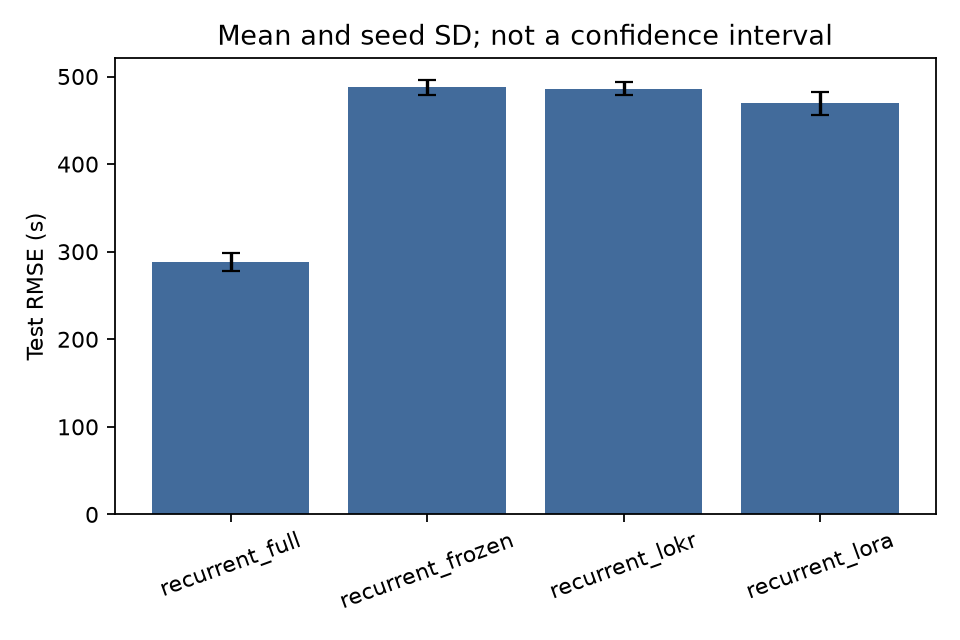
FA crosslinks show the clearest separation: full fine-tuning reduces RMSE by approximately 41% relative to frozen training. The adapters leave most of that deficit unresolved at the tested rank and learning-rate ratio.
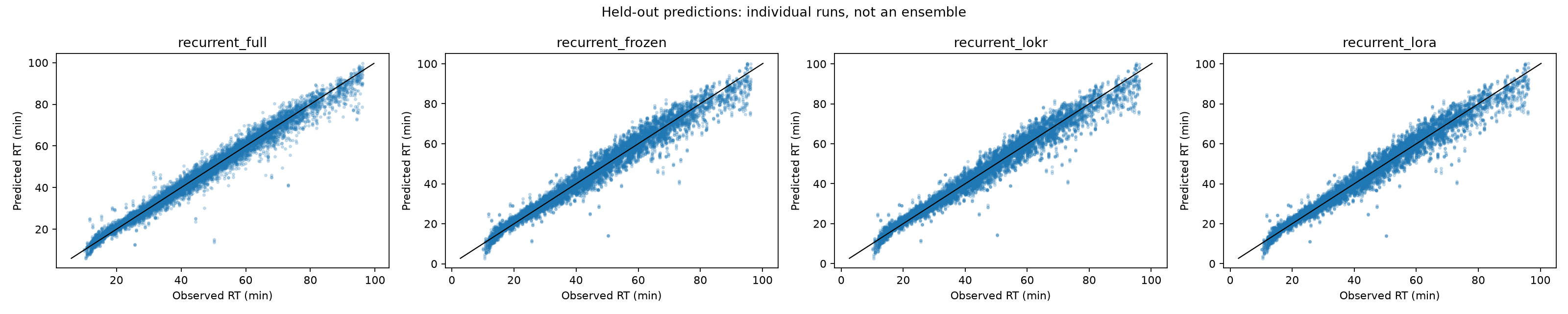
E. coli linear peptides retain substantial full-fine-tuning seed variability. The tighter dispersion of frozen/adapted runs comes with higher mean error, not improved accuracy.
Parameters and measured training time
The benchmark uses compact recurrent networks. Frozen heads train 289 parameters; LoKr trains 441 and LoRA 769. Full training updates 1,729–1,833, depending on cohort vocabulary size. These counts describe this architecture, not a large pretrained protein model.
| Cohort | Full (s) | Frozen (s) | LoKr (s) | LoRA (s) |
|---|---|---|---|---|
| E. coli crosslinks | 53.1 | 10.9 | 36.2 | 31.5 |
| E. coli pLink crosslinks | 48.4 | 10.8 | 32.0 | 31.0 |
| FA crosslinks | 5.7 | 1.2 | 4.7 | 5.8 |
| FA linear peptides | 9.7 | 2.1 | 5.9 | 6.8 |
| E. coli linear peptides | 106.8 | 23.6 | 57.8 | 76.6 |
Times are means of the recorded fitting calls, excluding starting-checkpoint pretraining, data preparation and exports. Early stopping can change executed epoch counts. Shared-host contention and implementation overhead mean that parameter ratios do not predict elapsed-time ratios.
Protocol
| Setting | Value |
|---|---|
| Cohorts | E. coli crosslinks, pLink crosslinks, FA crosslinks, FA linear peptides, E. coli linear peptides |
| Seeds | 17, 29, 43 |
| Strategies | Full model, frozen encoder, GRU-LoKr, GRU-LoRA |
| Budget | At most 30 additional epochs per run |
| Optimizer | AdamW; base learning rate 0.003, weight decay 0.01 |
| Batch size | 64 |
| Adapters | Rank 4, alpha 4; LoKr factor 4 |
| Adapter learning rate | 0.1 × base learning rate |
| Scheduler | Validation plateau; factor 0.5, patience 3 |
| Early stopping | Validation loss, patience 8 |
| Device | CPU, two PyTorch threads |
The starting checkpoints were trained only on the outer training partition. All four strategies retain the same architecture, vocabulary, grouped splits and training-only target normalization. Full training updates all model parameters; frozen training updates the prediction heads; LoKr/LoRA update GRU gate adapters and heads while preserving the base encoder parameters.
Validation loss selects the best epoch. The checkpoint is then saved, reconstructed and scored on the held-out test rows. The pipeline checks that frozen weights and encoder normalization buffers have not changed.
Retained outputs
benchmark-tf-torch/fine-tune-torch/ contains the resolved protocol, environment,
frozen source, per-run checkpoints, histories, predictions and quality records.
results/metrics.csv contains train/validation/test scores;
results/test-summary.csv summarizes held-out errors across seeds;
results/plots/<cohort>/ contains prediction, residual and RMSE figures.
The SHA256 index covers each published artifact. Verification recomputes per-run metrics and the aggregate tables:
To rerun on the current environment without overwriting measured output:
The original measurement used Python 3.12.3 and PyTorch 2.14.1 on CPU; exact
package versions and source hashes are recorded in protocol.json and
environment.json. The current development interpreter may differ. A changed
source, environment or configuration requires a distinct output directory.
The frozen protocol identity is
2eae9f1a7aefab5c8b66459b801abb88828ac75a18517a0617db110d8c0305e6.
The archived source is the implementation used for these measurements, not
a copy of the current application. Activity and kernel penalties are zero in
this protocol. Use the saved source and environment for exact reproduction;
use the current package for new experiments.
Interpretation
This is staged within-cohort training, not external transfer learning. The base and adaptation stages use the same outer training set, never the held-out pairs. Three seeds share one partition and the cohorts are correlated views of two studies. Initialization-seed standard deviation is not a confidence interval.
The learning rate, rank and adapter-rate ratio were fixed, not separately tuned for each strategy. Results therefore describe this operating point, not the best achievable LoRA, LoKr or full-fine-tuning performance. Parameter savings are useful engineering properties but do not establish accuracy or runtime superiority.
See the fine-tuning API and YAML for production usage.